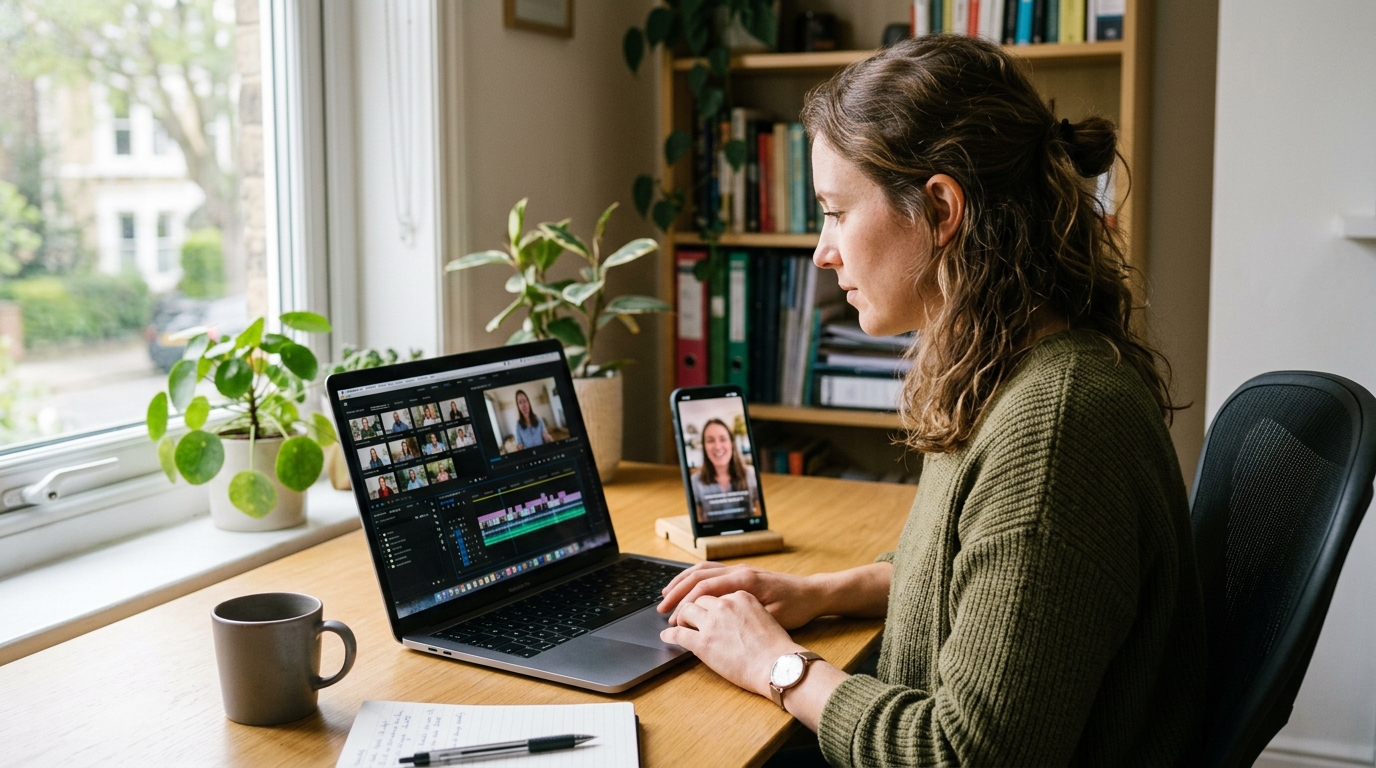
UGC video ads are ads built from real customers talking on camera, and most brands pay creators and agencies to manufacture that look. If you collect video testimonials, you already own the real thing: a library of customers describing their experience in their own words. One strong 60-second customer video can work four jobs, proof on your website, creative in your paid ads, content on your social channels, and evidence in your sales conversations. What stands between a testimonial library and an ad library is smaller than most operators think: consent collected with the right scope, editing light enough to preserve what makes the video persuasive, and placement matched to where the buying decision happens.
What UGC is, and why brands pay so much for it
User-generated content is content that looks like a customer made it, ideally because one did. Advertisers chase it for a simple reason: people have learned to scroll past polished brand creative, while a real face talking into a phone camera reads as native to the feed and gets judged as a person rather than an ad. The psychology behind that, identity, voice, unprompted specifics, is covered in why a real face beats five stars.
The industry's response produced a quiet irony: brands now commission "UGC creators" to act like customers, paying for the appearance of authenticity. If you've been collecting genuine customer videos, you're sitting on the asset everyone else is simulating, with provenance the simulations can't have.
The four jobs one customer video can do
Job 1: the website
Place video where the decision happens, not where the design looks tidiest: beside the booking button, on the product page, next to pricing. A visitor at the moment of commitment is asking one question, "did this work for someone like me?", and a real customer answering it on camera reduces that uncertainty in a way copy can't. An embedded wall of curated customer videos turns the most skeptical page on your site into the most persuasive one.
Job 2: paid ads
Customer videos are native creative for Meta, TikTok, and YouTube placements: vertical, phone-grade, human. Two practical rules. First, the hook is usually already in the recording; a customer's first unprompted sentence ("I almost didn't book this") often outperforms anything a copywriter would script. Second, test clips close to as-recorded before investing in edits, because the rough texture is the part that stops the scroll. Cut to the strongest 15 to 30 seconds, caption it for sound-off viewing, and let the person carry it.
Job 3: organic social
The same recordings feed your own channels as posts, reels, and stories, but the larger opportunity runs the other way. Send every customer a copy of their own video. Many will share it to their own network, where their face carries more weight than your logo ever will, and that reach costs you nothing. Make it part of the ask: tell customers they'll get their video to share however they like.
Job 4: sales conversations
For services, B2B, and anything with a proposal stage, a 30-second clip of a customer who looks like the prospect does what a logo wall and three bullet points never have. Drop a relevant clip into the deck, the proposal, or the follow-up email. The prospect hears a peer instead of a pitch.
Consent: the part that makes or breaks all of it
Permission to show a video on your website is not the same as permission to put someone's face in paid advertising. Using a person's likeness in ads without consent that covers advertising creates real legal risk in many jurisdictions, and it burns trust with the exact customers who liked you enough to record.
The clean solution is to capture consent at the moment of recording, with the scope stated plainly: public display, social channels, and advertising. Keep a timestamped record of what each customer agreed to. If your existing recordings were collected with narrower or unclear scope, re-ask before running ads; customers who recorded willingly usually say yes when asked respectfully, and the ask itself reads as care. This is why Outhentik logs every consent event in a timestamped, append-only audit trail tied to each video, with the exact notice text the customer saw, so the question "can we run this clip as an ad?" has a documented answer instead of a guess. However you collect, the principle holds: consent is part of the asset, and an unconsented video is not an asset at all.
One more disclosure rule. Genuine, unpaid customer testimonials need no disclaimer. The moment you compensate someone for their video, the FTC's Endorsement Guides require that material connection to be disclosed in the ad. The simplest path is the honest one: collect real, unpaid customer voices and keep it that way.
Editing without killing the asset
The goal of editing a customer video is to remove friction, not personality. Trim the dead air at the start and end. Find the strongest 15 to 30 seconds for ad cuts and keep the full version for your site. Add captions, since most feed viewing happens with sound off, but keep them clear of the face. Crop to vertical for feed placements.
Then stop. Leave the pauses, the laugh, the search for a word; those are the trust signals doing the work. No music bed over the voice, no jump-cut gloss, no stock footage sandwich. A practical output set from one recording: the full 60-second website version, one 15-to-30-second ad cut, and one 6-to-10-second hook clip for stories. Three assets, twenty minutes of work, zero production budget.
What NOT to do
Don't run ads with a face whose consent didn't clearly cover advertising. Re-ask first, every time.
Don't fake it and don't generate it. The FTC's 2024 final rule on fake reviews prohibits fake and AI-generated testimonials, with civil penalties of up to $51,744 per violation, and a single discovered fake poisons every real video you own.
Don't pay for praise without disclosure. Compensated endorsements carry a disclosure obligation under the FTC's Endorsement Guides, and "we gave them a discount for a nice video" counts.
Don't over-edit into a commercial. Every layer of polish moves the clip from "customer" to "ad," and the viewer's filter updates accordingly.
Don't put words in the customer's mouth. Overlay text claiming results the person never stated turns their genuine statement into your unsubstantiated claim.
And don't let the library rot in a folder. Tag each video by topic, customer segment, and consent scope as it arrives, so the right clip is findable the day a campaign needs it.
What to expect, realistically
A handful of strong videos outworks dozens of mediocre ones, and the library compounds: a steady trickle of recordings becomes a real creative pipeline over a quarter. In paid channels, treat every clip as a test; some customer videos will carry a campaign and others won't move at all, which is normal creative testing, not a verdict on the approach. No one can honestly promise you a click-through rate. What's certain is the cost side: this is ad creative you didn't pay to produce, from people who weren't paid to perform, with consent you collected once and own forever.
Frequently asked questions
What are UGC video ads? UGC video ads are paid ads built from user-generated content: real people, usually customers, talking on camera in a native, phone-shot style. They exist because audiences trust people more than polished brand creative, and the strongest version is a genuine customer testimonial rather than a commissioned imitation of one.
Can I use customer testimonial videos in paid ads? Yes, provided the customer's consent covers advertising use, not just display on your website. Capture that scope at the moment of recording and keep a timestamped record. If existing videos were collected with unclear scope, ask again before running the ad.
Do I need to pay customers for UGC? No, and unpaid is better. Genuine customer testimonials need no disclosure and carry more credibility. If you do compensate anyone for content used in ads, the FTC's Endorsement Guides require the material connection to be disclosed.
Is AI-generated UGC legal to use? Not as testimonials. The FTC's 2024 rule on fake reviews prohibits fake and AI-generated reviews and testimonials, with penalties of up to $51,744 per violation. Beyond the law, generated praise defeats the entire purpose of social proof.
What makes a good testimonial ad cut? A hook in the first two seconds (often the customer's own first sentence), 15 to 30 seconds of length, captions for sound-off viewing, vertical framing for feeds, and minimal editing so the person still reads as a person.
How many customer videos do I need to start? A few. One strong recording yields a website version, an ad cut, and a hook clip, so testing can begin with the first handful of videos while the library keeps growing behind it.
How should I keep consent organized? Capture the consent scope at recording time, store it with a timestamp alongside each video, and tag the library by topic and permission level. The test is simple: for any clip, you should be able to show exactly what its subject agreed to, and when.
Try Outhentik free for 7 days - no credit card required →
Outhentik opens a direct channel between businesses and their customers: video testimonials, compliant Google review growth, and customer recovery from one flow. The video library it produces is the ad budget most businesses never knew they had.